
India’s Dairy Evolution in 2025: A Shift Toward Conscious Consumption
- Pintu Rai
- Aug 7, 2025
- 2 min read

Updated: Sep 10, 2025
India has long held the title of the largest producer and consumer of dairy in the world. But as we cross into the second half of 2025, the industry is undergoing a quiet revolution. Consumers, especially in cities like Noida and Greater Noida, are no longer just asking how much milk they consume, but where it comes from, how it’s produced and what it contains.
And that’s exactly where platforms like ours … FarmLokal are making a difference.
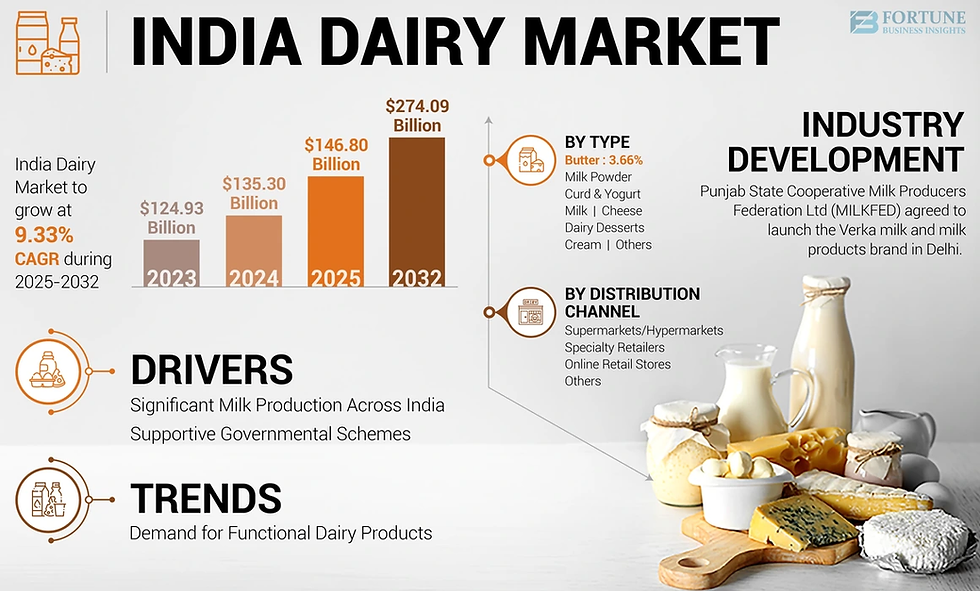
Source: Fortune Business Insight 1. Rise in Small-Scale, Ethical Dairies
The traditional dairy industry, dominated by mass production and profit-focused cooperatives, has led to several issues, including overuse of antibiotics, hormonal injections in cattle, and low-quality feed. But in 2025, consumers are choosing transparency over convenience.
FarmLokal, for example, partners with farmers that focus on:
Ethical animal care
No synthetic growth hormones
Grass-fed or naturally fed cattle
Clean, sustainable milking processes
This not only supports rural livelihoods but ensures you’re not compromising on quality or health.
2. Health-Conscious Families Are Reading Labels
Post-COVID and now into 2025, Indian middle-class households have become far more label-aware. They’re checking for:
FSSAI certifications
No additives or preservatives
Natural shelf life
At FarmLokal’s recent pop-up events, many residents asked detailed questions about dairy purity, sourcing and nutritional value. We had fulfilling conversations with customers regarding organic certifications that the government provides. There’s growing demand for buffalo ghee, A2 milk, and traditional curds that align with Ayurvedic principles and gut health.
3. Sustainability Is No Longer Optional
Large-scale dairy production contributes significantly to greenhouse gas emissions, water usage and waste. In 2025, climate-conscious consumption is influencing purchasing decisions. Urban shoppers are willing to pay a little more if it means:
Fewer food miles (local sourcing)
Reusable or glass packaging
Transparent waste disposal
FarmLokal’s hyperlocal model fits beautifully here; it reduces carbon footprints and supports local producers with cleaner, low-impact operations.
4. Demand for Artisan Dairy Products Is Rising
In addition to regular milk and paneer, there’s a booming niche for:
Artisan ghee (like Arth Heritage’s Pure Buffalo Ghee)
Flavoured curds and probiotic yoghurts
Farm-made butter and cream These products don’t just satisfy cravings, they tell a story of heritage, craft and quality. FarmLokal makes such niche items accessible to everyday urban families.
The FarmLokal Advantage for Dairy in 2025
With doorstep delivery in Noida and Greater Noida, curated product listings, verified certifications, and personal interaction with local producers, FarmLokal is more than just a grocery portal. It’s reshaping how dairy is discovered, delivered and consumed.


