
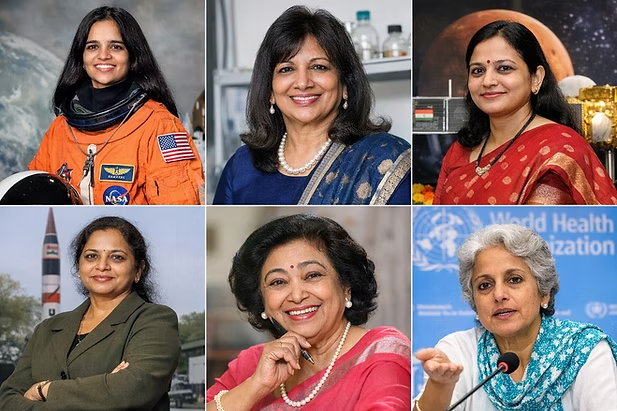
February 11 marked the International Day of Women and Girls in Science. Even though the date has passed, the stories of India’s women scientists deserve to be told year-round. Their journeys are not just inspiring headlines. They are reminders that curiosity, courage, and consistency can break barriers that once seemed immovable.
Take Dr. Kalpana Chawla, the first woman of Indian origin to travel to space. Born in Karnal, her journey from a small-town dreamer to a NASA astronaut became a symbol of possibility for countless girls across the country. Though her life was tragically cut short, her legacy continues to ignite ambition in young minds.
In the field of biotechnology, Dr. Kiran Mazumdar-Shaw, founder of Biocon, built one of India’s leading biopharmaceutical companies. At a time when women entrepreneurs in science were rare, she proved that innovation and leadership can coexist with empathy and resilience.
Space research in India would look different without Dr. Ritu Karidhal, often called the “Rocket Woman of India.” As a senior scientist at ISRO, she played a pivotal role in India’s Mars Orbiter Mission. Her story shows how scientific excellence can emerge from disciplined learning and relentless focus.
Then there is Dr. Tessy Thomas, known as the “Missile Woman of India.” As the Project Director for India’s Agni missile programme, she broke stereotypes in a traditionally male-dominated defence research field. Her work stands as proof that technical mastery has no gender.
In mathematics, Dr. Shakuntala Devi captured global attention with her extraordinary mental calculation abilities. While she was popularly known as the “Human Computer,” her deeper contribution was normalising the idea that women could dominate in numbers, logic, and analytical thinking.
India’s public health sector has also benefited from leaders like Dr. Soumya Swaminathan, former Chief Scientist at the World Health Organization. Her work in tuberculosis research and global health policy has influenced healthcare systems worldwide.
What makes these women significant is not just their individual achievements, but the pathways they opened. They stepped into laboratories, control rooms, research facilities, and boardrooms at a time when representation was limited. Their presence quietly shifted norms.
Publishing this reflection today is deliberate. Recognition should not be limited to one symbolic day. The larger goal is to create an ecosystem where the next generation of girls sees science not as an exception, but as an accessible path.
Because every time a young girl reads about Kalpana Chawla or watches ISRO scientists at work, she internalises one simple truth:
Science is not a space she has to enter carefully.
It is a space she belongs in.